
The Ultimate MTB Brake Fluid Guide: Mineral Oil vs DOT Fluid
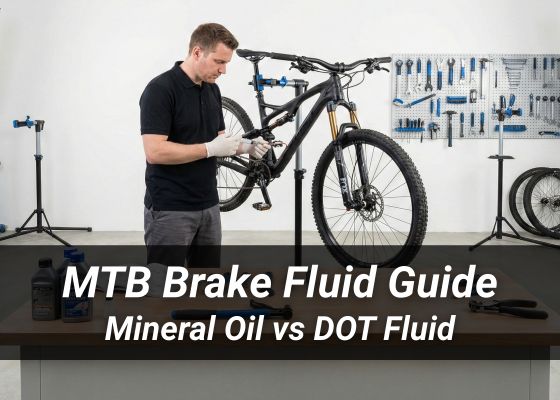
In mountain bike hydraulic disc brake systems, brake fluid is often overlooked, yet it plays a major role in both safety and braking performance.
Many riders spend money upgrading pads, rotors, or calipers, while ignoring the “blood” flowing through the brake lines. In reality, the type and condition of your brake fluid directly affect lever feel, braking consistency, and whether you experience brake fade on long descents.
Modern mountain bikes primarily use two types of brake fluid: Mineral Oil and DOT Brake Fluid. These fluids differ fundamentally in chemistry, maintenance needs, and thermal behavior, and they must never be mixed.
What Is MTB Brake Fluid and How Does It Work?
In a hydraulic disc brake system, brake fluid transfers force. When you pull the brake lever, the master cylinder piston pushes fluid through the hose. Because liquid is incompressible, pressure is transmitted instantly to the caliper, forcing the pistons outward and clamping the brake pads against the rotor.
Compared to cable-actuated brakes, hydraulic systems offer lower friction, higher efficiency, and better modulation. However, this depends on clean, uncontaminated fluid and a system free of air.
Quick Check: What Brake Fluid Does My Bike Use?
Do not rely on brand assumptions alone, especially as specifications have changed in recent years. Always check the reservoir cap on the brake lever. It will clearly state “Mineral Oil Only” or a DOT rating such as DOT 4 or DOT 5.1.
| Brake Fluid Type | Common Brands and Models |
|---|---|
| Mineral Oil | Shimano (all models) Magura (all models) TRP / Tektro (all models) SRAM (newer platforms: Maven, DB8) |
| DOT Fluid (DOT 4 / 5.1) | SRAM (legacy models: Code, G2, Guide, Level) Hope Hayes Formula |
Mineral Oil vs DOT Fluid: Core Differences Explained
1) DOT Fluid: Hygroscopic Behavior and Boiling Point
DOT brake fluid used in MTB systems is typically DOT 4 or DOT 5.1 and is glycol-based.
Note: Never use DOT 5 (silicone-based) brake fluid. It is chemically incompatible with DOT 4 and DOT 5.1 systems and must never be used in mountain bike hydraulic disc brakes.
DOT fluid is hygroscopic, meaning it absorbs moisture from the air.
This moisture absorption acts as a safety mechanism. Water is absorbed into the fluid rather than pooling as free water. Over time, this lowers the boiling point from the dry boiling point (often around 260°C) to a wet boiling point (often around 180°C). Even so, the system remains functional well above 100°C.
The downside is that DOT fluid is corrosive. Any spills on paint or frames should be rinsed immediately. Because it continuously absorbs moisture, DOT fluid should be replaced regularly, typically once per year.
2) Mineral Oil: Water Separation and the Hidden Risk
Mineral oil is petroleum-based and hydrophobic. It does not absorb water, and oil and water remain separate.
This makes mineral oil non-corrosive and more forgiving during maintenance. It is safer for painted surfaces and skin, and it remains chemically stable for long periods.
However, if moisture enters the system, it can settle at the lowest point, usually inside the caliper. This trapped water boils at only 100°C. Under heavy braking heat, it may vaporize suddenly, causing a rapid loss of hydraulic pressure and braking power.
Contrary to outdated myths, modern high-quality mineral oils often have dry boiling points in the 200°C to 280°C range. The real risk is water contamination, not the oil itself.
Side-by-Side Comparison
| Comparison Item | DOT Fluid (DOT 4 / 5.1) | Mineral Oil |
|---|---|---|
| Main composition | Glycol-based synthetic fluid | Petroleum-based refined oil |
| Reaction to moisture | Absorbs water into the fluid | Does not absorb water; moisture can settle |
| Boiling point behavior | High dry boiling point; wet boiling point decreases over time | Depends on formulation; trapped water boils at 100°C |
| Corrosiveness | Corrosive to paint and finishes | Non-corrosive and maintenance-friendly |
| Service interval | Typically once per year | Every 1–2 years depending on lever feel |
| Mixing risk | Must never be mixed with mineral oil | Must never be mixed with DOT fluid |
Why Mixing Brake Fluids Is Extremely Dangerous
Mineral oil and DOT fluid are chemically incompatible. Brake systems use different seal materials designed for each fluid type.
- DOT systems typically use EPDM rubber seals
- Mineral oil systems typically use NBR rubber seals
Using the wrong fluid can cause seals to swell, deform, or break down, leading to leaks, sticking pistons, or complete brake failure. Once contaminated, internal seals often require full replacement. There is no safe workaround. Always use the fluid specified by the manufacturer.
Maintenance: When Should You Change Brake Fluid?
DOT systems: follow a time-based schedule
Because DOT fluid absorbs moisture continuously, its boiling point decreases over time even if the bike is not ridden. Annual fluid replacement is strongly recommended.
Mineral oil systems: go by feel and condition
Mineral oil does not degrade easily, but contamination and moisture can still accumulate. A service interval of 1.5 to 2 years is typical, or sooner if lever feel deteriorates.
Signs your brakes need bleeding
- Spongy or inconsistent lever feel
- Increased lever travel
- Brake fade on long descents
- After hose cutting, caliper replacement, or system disassembly
Common Myths and Q&A
Q1: SRAM’s Maven and DB8 use mineral oil. Does that mean mineral oil is “better”?
A: Not exactly. Mineral oil systems are often chosen for lower maintenance and easier handling. DOT fluid still has advantages in wet boiling point consistency over time, which is valuable in extreme heat use cases. That said, platforms like Maven show that with strong thermal management and seal design, mineral oil can perform at a top gravity-riding level.
Q2: Can I use Shimano mineral oil in Magura brakes?
A: Manufacturers strongly advise against it. Even within “mineral oil,” viscosity and additive packages vary by brand. Mixing can change lever return speed and braking feel, and may void your warranty. For best performance and reliability, use the fluid specified by the brake manufacturer.
Final Thoughts
Mineral oil and DOT fluid are not inherently better or worse. They are simply different.
DOT fluid favors consistent performance under extreme heat but requires strict maintenance. Mineral oil is more maintenance-friendly and safer to handle, provided moisture is kept out of the system.
No matter which system your bike uses, regular brake inspections, timely pad replacement, and proper fluid maintenance are essential for safe riding.
Ride Fearless.